
What Makes Wireless Reliable in KSA’s Smart Infrastructure
Read Below
Wireless reliability in smart infrastructure is determined by system-level engineering discipline, where PCB architecture, antenna placement, grounding integrity and power-distribution noise control directly govern RF stability in dense electronic environments.
Coexistence planning across RF, digital and power domains is essential as multi-radio platforms, high-speed interfaces and switching converters share compact spaces, requiring early-stage filtering, shielding and return-path design.
Certified wireless modules from Würth Elektronik combined with engineering-led integration by McKinsey Electronics ensure deployment-ready connectivity aligned with real Saudi operating conditions.

Smart city platforms and industrial IoT systems are expanding rapidly across utilities, mobility networks and connected infrastructure. As device density increases, wireless links become foundational system layers that strongly influence data integrity, control-loop responsiveness and long-term maintainability of distributed assets.
In dense electronic environments, RF reliability is shaped less by nominal radio specifications and more by electromagnetic behavior at system level. Coexistence challenges intensify as high-speed digital interfaces, switching regulators and multi-radio architectures share compact board space. Deterministic wireless performance therefore depends on disciplined antenna layout, grounding strategy and power-distribution integrity.
RF Stability as a System-Level Discipline
Wireless performance begins at PCB architecture. Ground plane continuity influences antenna radiation efficiency and return-path stability, while discontinuities from split planes or stitching gaps distort current flow and degrade far-field behavior.
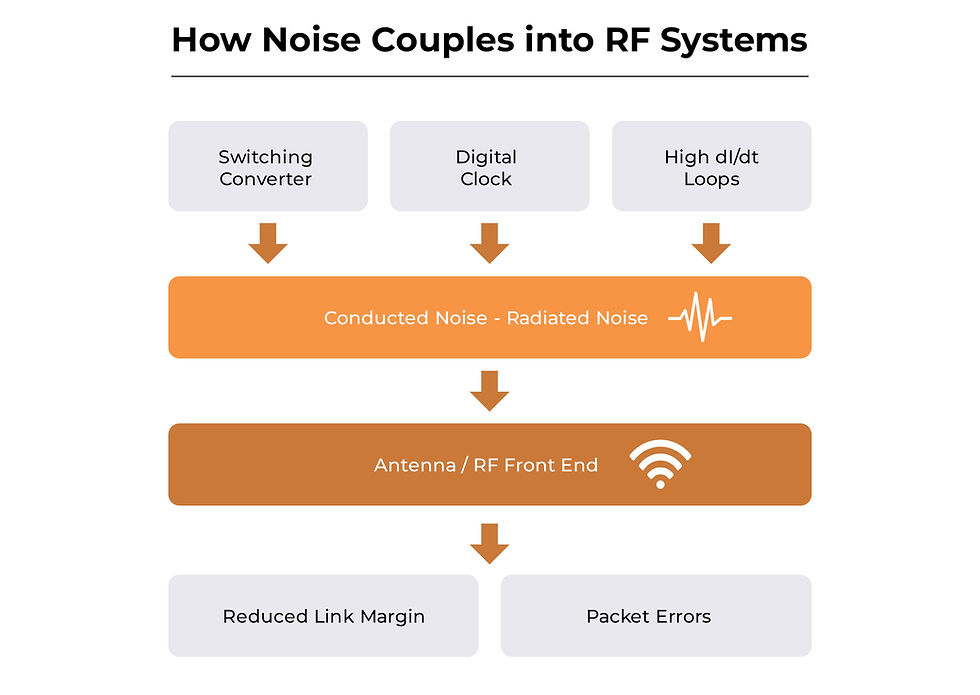
Antenna placement must respect keep-out volumes, radiation directionality and near-field coupling constraints. Locating antennas near switching inductors, converters or high di/dt loops introduces broadband noise that elevates the receiver noise floor and reduces link margin.
Power integrity is equally critical. RF front ends are highly sensitive to ripple and transient noise on supply rails. Inadequate decoupling, poor regulator response or excessive supply noise can increase oscillator phase noise and frequency instability that propagate into modulation accuracy and packet error rates.
Wireless reliability is fundamentally linked to ground reference quality, PDN impedance control and switching-noise containment across the RF spectrum.
Coexistence in Dense Electronic Architectures
Smart infrastructure nodes increasingly converge multi-band radios, edge processors and power-dense conversion stages within compact enclosures. This integration creates RF coexistence constraints where switching-frequency harmonics and broadband noise generated by power converters can fall within or interfere with ISM bands, fast clock edges generate broadband interference and enclosure cavities distort propagation patterns.
Mitigation requires synchronized design across RF, power and digital domains. Filtering hierarchy, return-path engineering and shielding geometry must be defined at architecture stage rather than corrected through late EMC fixes.
Certified Wireless Integration for Scalable Deployment
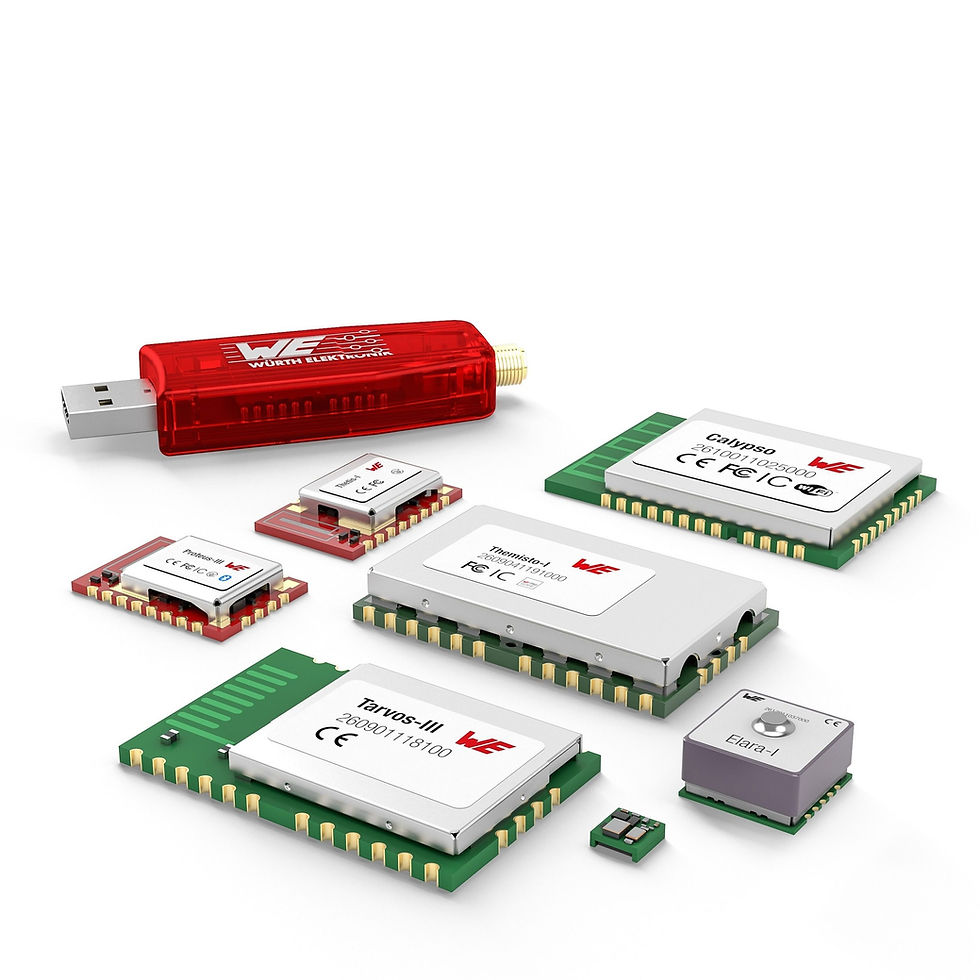
Würth Elektronik develops certified Bluetooth® and Wi-Fi modules engineered for predictable RF behavior and accelerated regulatory alignment.
Integrated antenna architectures reduce layout uncertainty and significantly reduce feedline mismatch risks. Pre-certified radio platforms shorten compliance cycles and de-risk global deployment, while firmware-over-the-air capabilities enable lifecycle fleet management where physical access is limited.
Module-level RF stability is preserved through controlled impedance paths, shielding structures, EMC-resilient reference designs and power filtering networks tuned for RF noise suppression. Yet propagation consistency remains sensitive to enclosure materials, chassis grounding, thermal drift and environmental exposure. Metallic housings detune antennas, composite materials alter radiation efficiency and temperature gradients shift oscillator stability.
From Module Capability to System Reliability
Industrial deployments across the GCC, especially in the KSA, operate under harsh environmental and electromagnetic conditions that differ significantly from lab validation. Wide temperature ranges, dust exposure, reflective urban structures and dense RF ecosystems impose additional link-budget and stability constraints.
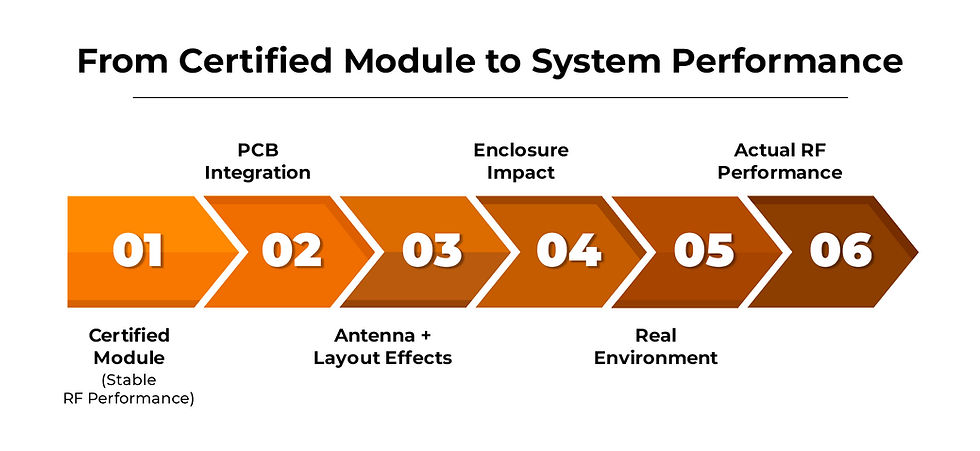
As an authorized distributor, McKinsey Electronics bridges wireless module capability with system-level integration through RF-aware layout review, antenna optimization, power-distribution validation, enclosure impact assessment and pre-compliance EMC planning aligned with regional operating realities.
This engineering layer ensures wireless links remain stable not only in certification environments but across real infrastructure deployments.
Reliable Connectivity as Infrastructure Backbone
As smart infrastructure scales, wireless reliability becomes primarily an engineering outcome rather than being left to chance rather than a probabilistic feature. Link budgets must incorporate coexistence with other RF systems and expected interference environments, antenna systems must be treated as electromechanical structures and power integrity must be engineered as an RF performance variable.
Certified modules accelerate integration. System-level RF discipline preserves performance. Localized engineering ensures deployment reliability.
That is how connectivity supports next-generation smart infrastructure.
Continue the conversation at LEAP Riyadh 2026 – Booth H4.E78.


