
Strategic Semiconductor and Electronic Component Trends to Shape 2026: Market Dynamics, Technological Shifts and System-Level Imperatives
Updated: Jul 23

The electronic components and semiconductor industry enters 2026 at a pivotal inflection point shaped by sustained AI-driven demand, regional supply-chain restructuring, technology evolution beyond Moore’s Law and growing system-level performance constraints. Unlike recent years marked by inventory corrections or cyclical slowdowns, 2026 reflects deeper structural shifts in demand and investment that will directly influence design choices, manufacturing strategies, ecosystem planning and operational risk across the value chain.
Let’s explore the key trends emerging from these shifts and why they matter for design, supply-chain, and technology roadmap decisions.

Market Growth Dynamics: AI as a Structural Demand Driver
AI has transitioned from an application trend to the structural driver of semiconductor investment, reshaping capacity allocation and product roadmaps from logic processing to high-performance memory solutions.
Acceleration Toward a Near-$1T Market
Leading consensus indicators from the World Semiconductor Trade Statistics (WSTS) and industry associations project significant year-over-year growth in semiconductor revenues for 2026, with total sales projected to approach the $1 trillion threshold within the next growth cycle, driven primarily by AI-related logic and memory demand.
Logic and Memory Leading Growth
Memory and logic device segments are expected to grow at >30% rates, underscoring the centrality of AI workloads. Memory demand, particularly High-Bandwidth Memory (HBM), is being structurally reallocated toward AI data centers, creating tight supply in mainstream DRAM/NAND markets.
Semiconductor Technology and Architectural Shifts
Engineering emphasis in 2026 migrates from monolithic scaling toward integration-centric architectures that optimize system-level performance under power and latency constraints.
Edge AI and Domain-Specific Accelerators
Embedded and edge AI compute is becoming pervasive across industrial, automotive and IoT domains. 2026 will see growth in low-power AI accelerators and specialized compute engines embedded within sensors and microcontrollers.
Advanced Packaging Over Node Scaling
Performance gains are increasingly tied to heterogeneous integration, advanced packaging (2.5D/3D) and chiplet ecosystems rather than purely finer process nodes. Thermal management, interconnect density and package-level yield are strategic differentiators in system performance.
Photonics and High-Speed Interconnects
To sustain data rates required for large AI clusters and HPC systems, electrical interconnects are approaching energy and latency limits. Early deployment of silicon photonics and co-packaged optics is emerging as a structural requirement.
Supply Chain Resilience, Regionalization and Footprint Strategy
Regional Footprint and National Initiatives
Governments are actively reshaping the semiconductor manufacturing landscape through incentive structures (e.g., CHIPS Act expansions, EU–India agreements) that support regional fabrication, advanced packaging and strategic design ecosystems.
Nearshoring and Supply Chain Strategy
Nearshoring is becoming a strategic lever to mitigate logistics, geopolitical and trade risks. While nearshoring can involve higher manufacturing or labor costs in some regions, total cost of ownership considerations increasingly favor closer manufacturing footprints through reduced logistics complexity, improved responsiveness and advanced automation..
Capacity Investments in Memory and AI Nodes
Equipment and capacity expansion, particularly for logic and AI memory technologies, are forecasted to grow, with chip-making equipment sales expected to rise ~9% in 2026, reflecting capital investment in AI-centric fabs and back-end test/assembly infrastructure.
Component Engineering and System Integration Trends
Strategic Component Design and BOM Risk Management
Effective component strategies in 2026 will require alignment with system architectures and lifecycle planning. Reference designs, early validation and integrated compliance strategies are becoming engineering imperatives rather than post-design activities.
Testing, Validation and Reliability Engineering
As components become more heterogeneous and tightly coupled to domain-specific workloads, testing methodologies must evolve to include system-level stress scenarios, cross-domain compliance workflows and predictive reliability analytics.
Supply Chain Digitalization and Lifecycle Visibility
Digital end-to-end supply-chain platforms are increasingly necessary to manage bifurcated demand signals and part scarcity while ensuring lifecycle visibility and risk mitigation.
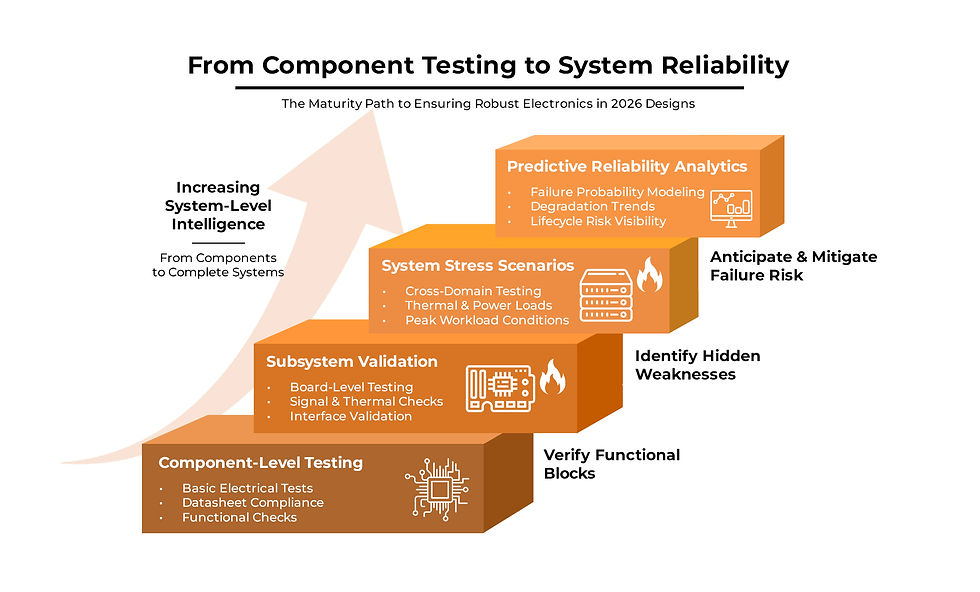
Emerging Risk and Cost Structures
Memory Supply Constraints and Price PressuresDriven by preferential capacity allocation toward HBM and AI infrastructure, ongoing memory supply shortages are exerting upward pressure on DRAM/NAND pricing and impacting consumer electronics BOMs.
CapEx Discipline vs. Growth ImperativesFoundries and IDMs face a balancing act between disciplined capital allocation and meeting surging demand for specialized AI silicon. This dynamic will influence pricing structures, lead times and competitive differentiation in 2026.

In 2026, the semiconductor and electronic components industry will be defined by AI-centric growth, architectural transitions to heterogeneous and integrated systems, supply-chain resilience strategies and engineering practice shifts toward systems-level design and risk visibility. For technical leaders, the imperative is clear: align product roadmaps with AI workload demands, invest in advanced packaging and integration, embed supply-chain and reliability analytics early in design and strategically balance capacity risk against performance requirements. These structural trends will determine technology competitiveness in 2026 while also shaping the trajectories of adjacent industries, from automotive to industrial automation and edge intelligence.
At McKinsey Electronics, we work with global semiconductor manufacturers and system OEMs to translate exactly these kinds of structural shifts into actionable engineering, manufacturing and operating-model decisions. Our expert teams of engineers combine deep technical expertise with system-level economic and supply-chain insight to help organizations navigate AI-driven demand, advanced packaging transitions and regionalization strategies, while maintaining reliability, compliance and capital efficiency across the product lifecycle.
Sources


