
Repartitioning Signal Intelligence: Analog vs. Digital Conditioning Under Semiconductor and System Constraints
Read Below
Digital-only signal conditioning is increasingly limited by ADC scaling, noise and latency constraints, reducing overall system efficiency.
Analog preprocessing improves signal integrity before quantization, preserving dynamic range and reducing dependence on high-performance ADCs and DSP workloads.
McKinsey Electronics supports hybrid signal-chain design by aligning component selection and system-level architecture with real-world performance and power constraints.

Mixed-Signal system design is increasingly constrained by the physical and architectural limits of semiconductor technologies. The long-standing preference for digital-domain compensation, enabled by increasingly capable MCUs, DSPs and FPGA-based systems, has reached a point where further scaling often no longer delivers proportional system-level benefits.
Three constraints are converging:
The non-linear power scaling of high-resolution, high-speed ADCs
The increasing analog design challenges in advanced process nodes
The tightening of latency budgets in real-time and edge systems
These factors are forcing a reassessment of how signal conditioning is partitioned across the signal chain. The question is no longer whether digital processing can compensate for analog imperfections, but whether it should.
Programmable analog architectures, including Field Programmable Analog Arrays (FPAAs) particularly Field Programmable Analog Arrays (FPAAs), introduce an alternative: relocating part of the signal intelligence into the analog domain, before digitization. This shifts the problem from post-processing correction to pre-emptive signal optimization, with implications that extend beyond circuit design into system architecture and semiconductor strategy.
Limitations of the Digital-First Signal Conditioning Model
The digital-first approach to signal conditioning emerged as a natural consequence of Moore’s Law. As digital logic became cheaper and more powerful, it became efficient to simplify analog design and defer complexity to programmable digital blocks. However, this approach implicitly assumes that the signal entering the ADC is of sufficient quality to support downstream processing.
That assumption can become problematic in modern high-performance systems.
ADC Scaling and Energy Constraints
Unlike digital logic, ADCs are constrained by thermal noise, capacitor matching, and linearity requirements. These constraints prevent them from scaling efficiently with process node reductions. Increasing resolution or sampling rate leads to disproportionate increases in power consumption, making high-performance data conversion one of the dominant energy contributors in mixed-signal systems.
This creates a structural inefficiency: systems rely on increasingly power-hungry ADCs to compensate for insufficient analog conditioning.
Irreversibility of Signal Degradation
Signal degradation occurring before the ADC introduces a more fundamental limitation. Noise, interference and improper signal scaling reduce the effective dynamic range available for digitization. Once the signal is quantized, any information lost due to these factors cannot be reconstructed.
Digital filtering can suppress unwanted frequency components, but it cannot:
Recover clipped signals.
Restore resolution lost to poor scaling.
Separate signal from noise when both occupy the same quantization space.
This defines a hard boundary: the ADC does not merely convert signals: it limits what can be known about them.
Latency Accumulation in Digital Pipelines
Digital processing introduces unavoidable latency through sampling, conversion and computation. While each stage may be optimized individually, the cumulative delay becomes significant in systems requiring real-time response.
In control applications, this latency directly affects system stability. As loop delays increase, phase margins decrease, limiting achievable bandwidth and responsiveness. The result is a trade-off between computational flexibility and control performance.
Repositioning the Analog Front End as an Active System Element
The analog front end has traditionally been treated as a static interface between the physical world and the digital domain. This role is expanding. With the introduction of programmable analog fabrics, the front end becomes a configurable, adaptive component capable of modifying signal characteristics in real time.
Instead of performing minimal conditioning, the analog front end can now execute a range of functions that directly influence system performance. Gain can be adjusted dynamically to match signal amplitude to ADC range. Filtering can be tuned to suppress specific noise sources. Offset and drift can be compensated dynamically in some architectures rather than through calibration cycles.
This transforms the analog stage from a fixed constraint into a design variable, allowing engineers to optimize signal quality before it becomes constrained by digitization.
Dynamic Range Optimization and Effective Resolution
The performance of an ADC is often specified in terms of nominal resolution, but the more relevant metric in practical systems is effective number of bits (ENOB). ENOB reflects how much of the ADC’s theoretical resolution is actually usable under real-world conditions.
Poor signal conditioning reduces ENOB by either compressing the signal into a small portion of the input range or by elevating the noise floor. Both effects reduce the distinguishable levels available for representing the signal.
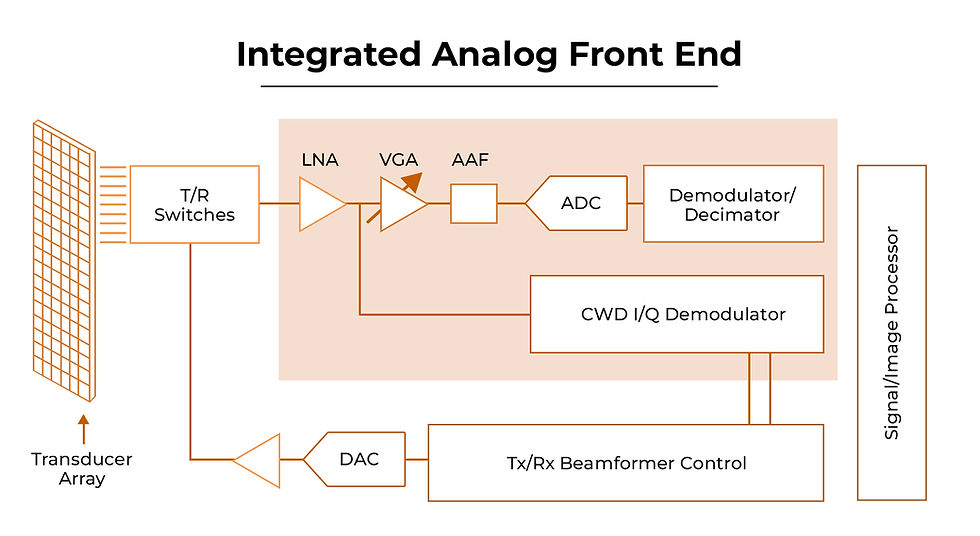
Programmable analog preprocessing addresses this by continuously aligning the signal with the ADC’s input range. When gain is adjusted appropriately, the signal occupies a larger portion of the available range, improving resolution without changing the converter itself. When filtering removes out-of-band noise, the effective noise floor is lowered, further enhancing ENOB.
From a system perspective, this has a direct impact on semiconductor selection. Instead of requiring higher-resolution ADCs, which carry penalties in power, cost and integration complexity, systems can achieve equivalent performance through improved front-end conditioning.
Latency as a Constraint on System Architecture
Latency is increasingly treated as a primary constraint rather than a secondary characteristic. This is particularly evident in systems where physical processes evolve on timescales comparable to digital processing delays.
Analog processing operates in continuous time, meaning that signal transformations occur without the need for sampling or buffering. The delays are typically limited to circuit propagation, settling and filter-related delays. In contrast, digital processing introduces discrete-time behavior, requiring signals to be sampled, converted and processed sequentially.
In feedback systems, these delays accumulate and directly influence stability. A system designed with minimal latency can respond quickly to changes, maintaining stability across a wider operating range. As latency increases, the system becomes more sensitive to disturbances and more difficult to stabilize.
By relocating certain functions, such as filtering, threshold detection or envelope extraction, to the analog domain, designers can reduce total loop delay. This is not simply an optimization; in some applications, it determines whether a control strategy is viable.

System-Level Power Implications
Power consumption in mixed-signal systems is not evenly distributed. Data conversion and digital processing frequently dominate the energy budget, particularly in high-performance or always-on applications.
When signal conditioning is deferred to the digital domain, the system must compensate through:
Higher ADC sampling rates to capture sufficient information.
Increased resolution to preserve signal fidelity.
Additional processing cycles to filter and interpret data.
Each of these increases power consumption.
Analog preprocessing changes this distribution. By shaping the signal before digitization, it reduces the requirements placed on downstream components. In some applications, the ADC may be able to operate at a lower resolution or sampling rate and the digital processor can execute fewer operations.
The key point is that power savings are realized at the system level, not necessarily within the analog block itself. This aligns with broader trends in semiconductor design, where efficiency is achieved through architectural optimization rather than isolated component improvements.
Toward Constraint-Driven Hybrid Architectures
The emerging design approach is not to favor analog or digital processing exclusively, but to allocate functionality based on where it can be performed most effectively under given constraints.
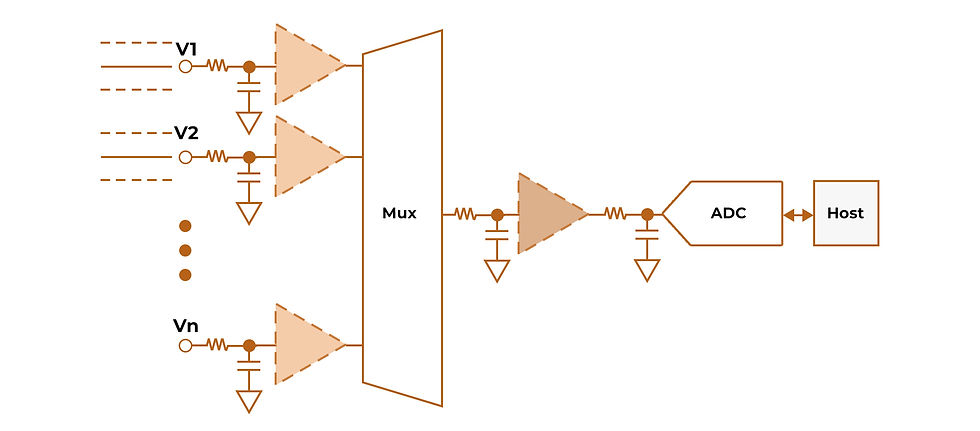
Functions that are sensitive to noise, latency or dynamic range are increasingly placed in the analog domain, where they can be addressed before information is lost. Functions requiring precision, programmability or computational complexity remain in the digital domain.
This partitioning is not static. It evolves with system requirements, semiconductor capabilities, and application constraints. The introduction of programmable analog makes this evolution more manageable, as it reduces the cost of shifting functionality across the analog–digital boundary.
The partitioning of signal conditioning between analog and digital domains is becoming a defining factor in mixed-signal system design. Semiconductor scaling limitations, energy constraints and latency requirements are exposing the weaknesses of a purely digital-centric approach. Digital processing remains essential, but it is inherently limited by the quality of the input it receives, while analog preprocessing restores control over signal integrity, dynamic range and real-time responsiveness before quantization.
The resulting shift is not a replacement of digital techniques, but a rebalancing of responsibilities across the signal chain. Systems that integrate analog and digital processing based on physical and architectural constraints can often achieve improved performance, efficiency and scalability.
In this context, McKinsey Electronics enables the practical implementation of these hybrid architectures by supporting component selection, front-end design strategies and system-level optimization across mixed-signal platforms. By aligning semiconductor capabilities with real-world system constraints, McKinsey Electronics helps engineering teams translate these design principles into deployable, high-performance solutions.


