
Engineering Storage for Long-Term Reliability: Industrial SSD Selection Beyond Capacity
Read Below
Industrial SSD selection extends far beyond capacity and interface, requiring careful evaluation of endurance, controller architecture, data integrity and environmental performance.
Continuous operation, power interruptions, vibration and temperature extremes introduce failure mechanisms that demand storage specifically engineered for industrial and embedded systems.
McKinsey Electronics provides engineering teams across the GCC and North Africa with authorized access to Exascend's industrial storage portfolio, supporting application-driven SSD selection through regional technical engagement.
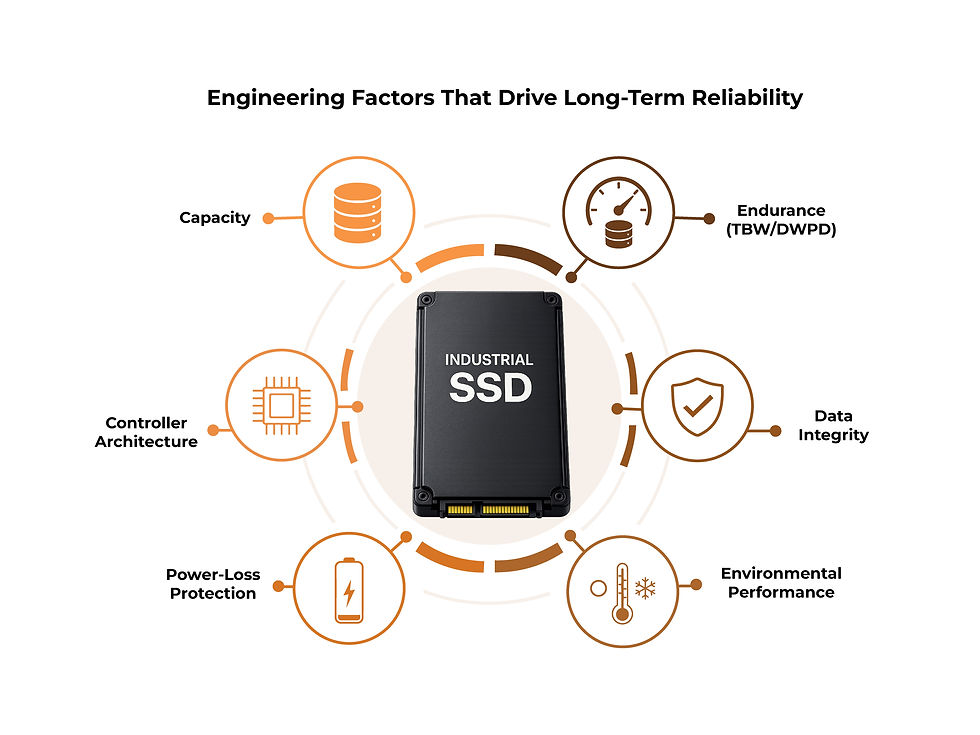
For many engineers, storage selection still begins with two specifications: capacity and interface.
If an application requires 1 TB of storage and supports PCIe Gen4, selecting an SSD can appear straightforward. However, this approach overlooks the engineering characteristics that determine how reliably the system will operate over years of continuous deployment.
Industrial storage is fundamentally different from consumer storage. While both may share the same interface and even similar NAND Flash technologies, the controller architecture, firmware design, endurance management and environmental qualification ultimately determine whether a storage device continues operating reliably after millions of write cycles, thousands of power interruptions and years of exposure to harsh operating conditions.
As embedded systems become increasingly data-intensive, selecting the correct SSD has become an engineering decision rather than simply a procurement exercise.
Understanding the Workload Before Selecting the Drive
The first question engineers should ask is not, "How much capacity do I need?" It is, "What will this drive actually do?"
A surveillance recorder continuously writes video streams around the clock. A machine vision platform repeatedly stores and retrieves high-resolution images for real-time processing. An industrial gateway logs sensor data while simultaneously running edge AI inference, and a medical imaging system stores large diagnostic files that must remain accessible and intact for many years.
Although these applications may require similar storage capacities, their workloads are fundamentally different. Understanding write intensity, read frequency, data retention requirements and expected service life enables engineers to select storage technologies that match the operating environment rather than relying solely on generic specifications.
Engineers should evaluate several characteristics together rather than focusing only on interface speed or capacity:
Write endurance (TBW and DWPD)
Latency consistency under sustained workloads
Controller architecture and firmware capabilities
Power-loss protection and data integrity
Operating temperature range and thermal management
These characteristics collectively determine how reliably an SSD will perform throughout its operational lifetime.
Endurance Is Often More Important Than Capacity

One of the most misunderstood SSD specifications is endurance.
Every NAND Flash memory cell has a finite number of Program/Erase (P/E) cycles. Each write operation gradually wears the flash until the cells can no longer reliably retain data. Industrial SSDs are specifically designed to manage this process through sophisticated firmware that maximizes usable lifetime without compromising performance.
This is why two SSDs with identical capacities may deliver dramatically different service lives under the same workload. The combination of NAND quality, controller intelligence and firmware optimization determines how efficiently write operations are distributed, how degraded memory cells are managed and how consistently performance is maintained over time.
For applications involving continuous logging, industrial automation or AI inference, endurance often becomes a far more important design parameter than storage capacity itself.
The Controller Is the Real Intelligence Behind an SSD
NAND Flash stores the data, but the controller determines how effectively that data is managed.
Modern industrial SSD controllers continuously perform wear leveling to distribute write activity evenly across the available flash memory, execute garbage collection to reclaim invalid data blocks and manage bad block replacement before deteriorating cells affect system reliability. Advanced Error Correction Code (ECC) algorithms continuously detect and correct bit errors, while background maintenance routines preserve performance as the drive ages.
These processes operate transparently throughout the lifetime of the SSD, ensuring predictable behavior under sustained workloads. In many industrial applications, controller firmware has a greater influence on long-term reliability than interface bandwidth alone.
Engineering for Harsh Operating Environments

Industrial electronics rarely operate inside temperature-controlled office environments.
Instead, they are deployed in factories, transportation systems, outdoor infrastructure and embedded platforms where environmental stress is part of normal operation. Storage devices used in these systems must therefore be engineered to tolerate conditions such as:
Continuous 24/7 operation
High vibration and mechanical shock
Wide operating temperatures
Electrical noise and unstable power
Limited airflow and restricted maintenance access
These conditions accelerate flash wear, increase controller temperatures and expose storage devices to unexpected power interruptions. Industrial SSDs address these challenges through extended temperature qualification, thermal optimization, power-loss protection and firmware specifically developed for sustained operation under demanding conditions.
Reliability Depends on Data Integrity

Performance specifications often dominate product comparisons, yet data integrity is frequently the more important engineering objective.
Unexpected storage corruption can interrupt manufacturing processes, invalidate diagnostic data, damage operating systems or require costly field service. Consequently, industrial SSDs incorporate multiple layers of protection that continuously preserve stored information throughout the product lifecycle.
End-to-end data protection, advanced ECC, metadata verification, SMART health monitoring and power-loss protection work together to minimize the probability of data corruption while providing engineers with greater visibility into storage health before failures occur.
Rather than simply delivering high transfer speeds, industrial SSDs are engineered to maintain predictable operation under continuous real-world workloads where reliability is more valuable than benchmark performance.
Selecting Storage for the Application
There is no universal SSD suitable for every embedded design.
Edge AI systems prioritize low latency and compact form factors. Industrial gateways require high write endurance for continuous sensor logging. Enterprise servers emphasize sustained Input/Output Operations Per Second (IOPS), while medical equipment demands uncompromised data integrity and long operational lifetimes. Transportation systems introduce vibration, thermal cycling and unstable power conditions that require additional environmental protection.
The correct storage solution therefore depends on understanding the complete application rather than comparing specification sheets. Storage should be evaluated as part of the overall system architecture alongside processors, memory, thermal design and power management.
Engineering Beyond the Datasheet
As embedded systems continue generating larger volumes of data, storage has become a critical contributor to system reliability, operational availability and lifecycle cost.
Selecting an SSD is no longer about purchasing capacity. It requires understanding workload characteristics, endurance requirements, controller architecture, environmental conditions and long-term support throughout the product lifecycle.
Through its partnership with Exascend, McKinsey Electronics provides engineers across the GCC and North Africa with authorized access to industrial and enterprise SSD and memory solutions supported by on-ground regional engineering engagement. By helping partners evaluate storage according to application requirements rather than headline specifications, McKinsey Electronics enables engineering teams to design systems that continue performing reliably long after deployment.
As storage moves closer to the center of modern system architecture, engineering decisions made during component selection will increasingly determine the long-term success of embedded, industrial and AI-driven electronic systems.


