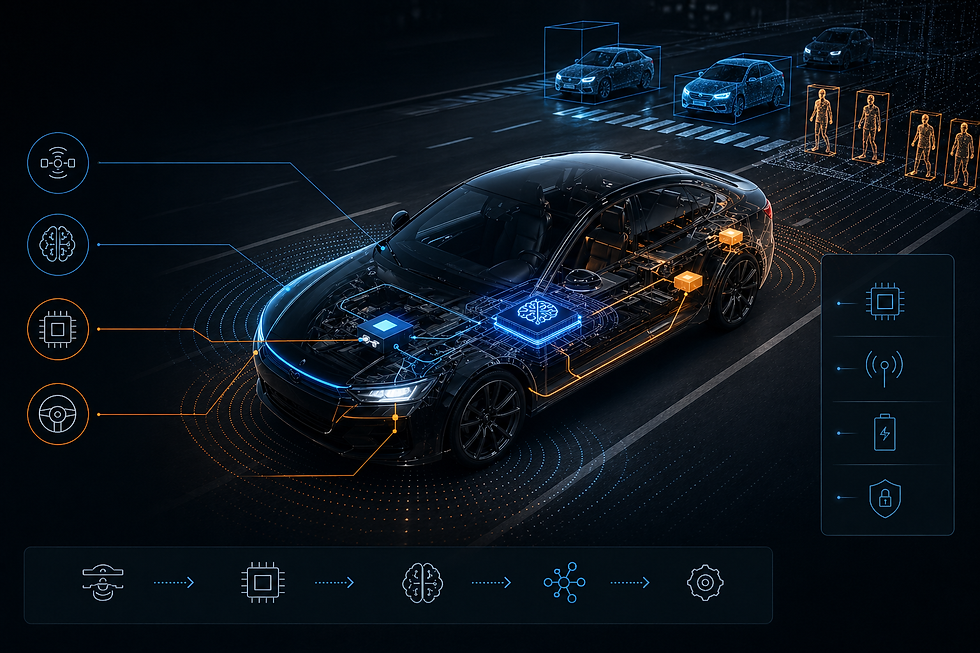
Building Trust at the Hardware Layer
Read Below
Authentication increasingly influences hardware architecture, computational behavior and long-term system lifecycle planning rather than operating solely as a software function.
Post-quantum cryptographic implementation introduces design considerations affecting memory allocation, processing resources, power behavior and hardware architecture.
McKinsey Electronics supports engineering teams across the Middle East and Africa with technologies and technical engagement aligned with evolving authentication and hardware security requirements.
Security Assumptions Are Changing at the System Level
For many years, security architectures followed a relatively predictable model. Hardware primarily provided computational resources while software environments handled authentication logic, credential management and access control policies. Security functions could often be introduced as implementation layers without substantially influencing the underlying system architecture.

Connected systems increasingly operate under different conditions.
Industrial automation platforms, transportation infrastructure, healthcare systems, communications equipment and distributed edge environments now function as interconnected ecosystems where users, devices and applications continuously exchange information across multiple environments. Many of these systems remain operational for ten years or longer while simultaneously operating under defined processing resources, thermal constraints and power limitations.
This creates a different engineering challenge.
The assumptions established during initial deployment frequently differ from the operational conditions encountered later in a system lifecycle. Security architectures therefore become increasingly influenced by long-term behavior rather than immediate implementation requirements.
Authentication consequently evolves from an implementation decision toward a broader architectural consideration.
Future Cryptography Is Already Affecting Current Design Decisions
Discussions surrounding post-quantum computing frequently focus on future computational capability and theoretical security implications. The engineering impact, however, is becoming relevant much earlier within practical design environments.
Infrastructure providers and security researchers increasingly evaluate scenarios involving long-term information protection where encrypted information generated today may continue carrying operational or strategic value many years into the future. This creates consideration for environments commonly associated with "store now, decrypt later" scenarios where information collected under existing cryptographic methods could eventually become accessible through future computational capabilities.
Long-lifecycle systems increasingly treat future cryptographic readiness as an engineering consideration rather than a distant research topic.
Industry standardization accelerated through approaches including ML-KEM, ML-DSA and SLH-DSA. Discussions subsequently shifted from selecting candidate algorithms toward understanding implementation requirements and deployment behavior.
The implementation stage introduces architectural implications extending beyond software execution.
Traditional public-key methods including RSA and elliptic curve cryptography primarily depend on integer arithmetic operations and relatively compact key structures. Post-quantum implementations frequently rely on lattice-based mathematical operations involving polynomial transformations, vector processing and larger cryptographic structures.
These differences affect multiple system parameters simultaneously.

Larger certificates influence memory allocation strategies. Different mathematical operations change processing workloads and computational behavior. Additional activity similarly affects power profiles, timing characteristics and side-channel analysis considerations involving electromagnetic emissions and power monitoring behavior.
Authentication therefore begins influencing silicon-level decisions.
Dedicated Hardware Increasingly Becomes Part of Trust Architecture
Semiconductor development has historically followed a predictable progression in which functions initially managed through software environments gradually transition toward dedicated hardware implementations as system complexity and computational requirements increase.
Signal processing evolved toward dedicated engines optimized for throughput and latency requirements. Artificial intelligence workloads increasingly rely on specialized accelerators designed for parallel computational efficiency, while power management capabilities similarly transitioned toward purpose-built silicon architectures intended to improve system efficiency and control.

Authentication increasingly appears to be following a comparable trajectory where trust mechanisms and cryptographic functions become integrated architectural elements rather than isolated software processes.
This transition changes more than computational efficiency.
Trust mechanisms increasingly migrate toward protected hardware environments where credentials and cryptographic operations remain isolated from broader operating systems and software environments. The change therefore influences where trust originates within the system itself.
Identity Systems Are Becoming Integrated Security Ecosystems
Recent authentication developments increasingly demonstrate how this transition is beginning to appear in practical implementations.

Swissbit's iShield authentication roadmap illustrates this movement through the expansion of hardware authentication capabilities beyond conventional FIDO environments. Recent developments introduced HID Seos integration supporting converged physical and digital access environments while simultaneously presenting a Post-Quantum Cryptography Evaluation Platform intended for future authentication evaluation and implementation readiness.
The significance extends beyond adding authentication features.
Traditional enterprise environments frequently maintain separate infrastructures across physical and digital environments. Facility access may depend on badge systems while applications, networks and enterprise systems maintain independent authentication workflows.
Multiple trust environments frequently create additional complexity across credential management and security operations.
Hardware-rooted architectures create opportunities to consolidate identity functions into protected environments where authentication credentials and cryptographic operations remain separated from broader software exposure.
Swissbit also previewed biometric verification with liveness detection as part of its longer-term authentication direction. This reflects a broader transition where authentication increasingly extends beyond user verification and evolves toward interconnected trust ecosystems operating simultaneously across users, devices and applications.
Identity therefore becomes increasingly associated with broader system architecture rather than isolated credentials.
Embedded Systems Operate Under Different Constraints
Cloud environments generally absorb increasing computational requirements through scalable infrastructure resources. Embedded environments operate differently.
Processing capability remains finite. Memory resources operate within defined boundaries. Thermal conditions influence reliability behavior and power consumption directly affects operational continuity.
Security requirements introduced later during development can therefore influence overall system performance and long-term system behavior. Future authentication capabilities increasingly become intertwined with component selection, resource allocation and lifecycle planning decisions.
For engineering teams developing platforms expected to operate throughout the next decade, security planning increasingly begins during architecture development rather than after deployment.
As an authorized Swissbit distributor, McKinsey Electronics supports regional engineering teams with access to trusted storage, authentication and hardware security technologies across the Middle East, Türkiye and Africa. Headquartered in Dubai and operating through a regional engineering and supply network, McKinsey Electronics combines authorized component access with system-level technical engagement extending from concept development through production deployment. Local engineering teams work closely with OEMs, EMS providers and R&D organizations to support architecture selection, component integration, lifecycle planning and supply continuity for high-reliability applications. Through engineering-led distribution, traceable sourcing practices and collaboration with global technology manufacturers, McKinsey Electronics helps organizations align future authentication requirements with practical implementation strategies designed for long-term system resilience and deployment continuity.